
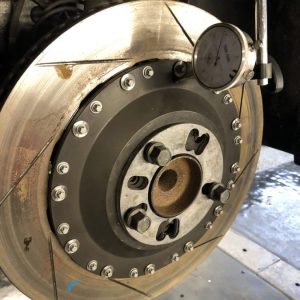
The Vehicle
Vehicle: BMW M3 E92
Project Type: Performance Brake Diagnosis and Repair
Brake System: AP Racing Floating Disc Assembly
Services Provided:
- Brake vibration diagnosis
- Precision runout measurement
- Floating disc inspection
- AP Racing brake system assessment
- Replacement brake hat installation
- Track-focused brake preparation
The BMW M3 E92 is a powerful and capable performance car, frequently used for demanding road and track driving. Under heavy braking, even a very small variation within the brake assembly can become noticeable through the steering wheel, pedal or chassis.
Customer Requirements
The customer reported a strong vibration when braking heavily.
In an attempt to resolve the problem, the brake discs and pads had already been replaced. However, the vibration persisted, indicating that the fault was likely to be elsewhere within the assembly.
Because the car used an AP Racing floating brake disc system, we suspected that one of the brake hats might not be running perfectly true.
The hat is the central section of the assembly that mounts the floating disc to the vehicle’s wheel hub. Any variation within the hub, hat or complete assembled disc can affect how consistently the disc rotates through the brake caliper.
The hats had also been replaced recently, so the owner had understandably considered them unlikely to be responsible. This meant the next stage required proper investigation and accurate measurement rather than assumptions.
The Challenge
The principal challenge was that there was no obvious visual defect.
The braking components were high-quality products, the discs and pads were new and the brake hats had also recently been replaced. Simply inspecting the system by eye would not have revealed the cause of the vibration.
After consulting AP Racing, we established that three separate measurements were required to assess the floating disc installation correctly:
- The variation at the wheel hub.
- The combined variation of the hub and brake hat.
- The variation of the complete hub, hat and floating disc assembly.
Each measurement had to be taken accurately on both the left and right-hand sides of the vehicle.
This process was essential because a fault detected at the complete disc assembly could originate from the hub, the hat, the disc or the relationship between those components.
Diagnostic Approach
Rather than replacing further parts, we began by establishing a set of accurate baseline measurements.
Both front brake assemblies were assessed systematically so the readings could be compared against AP Racing’s permitted tolerances and against each other.
The process allowed us to determine:
- Whether either wheel hub was running outside tolerance.
- Whether fitting the brake hat introduced additional variation.
- Whether the final floating disc assembly remained within specification.
- Which individual component was responsible for any excessive runout.
This staged approach prevented one inaccurate component from being incorrectly blamed for variation caused elsewhere in the assembly.
Work Carried Out
Hub Measurement
The first measurements were taken directly from each wheel hub.
This established whether the foundation of the brake assembly was running true. Any excessive variation at this stage would have affected every component subsequently mounted to the hub.
The hub readings provided the first reference point for the investigation.
Hub and Brake Hat Measurement
The AP Racing brake hats were then fitted and the combined hub-and-hat variation was measured.
Comparing these figures with the original hub readings allowed us to identify whether either hat was introducing additional runout into the assembly.
Complete Floating Disc Measurement
The final measurements were taken with the brake hats and floating discs fully assembled.
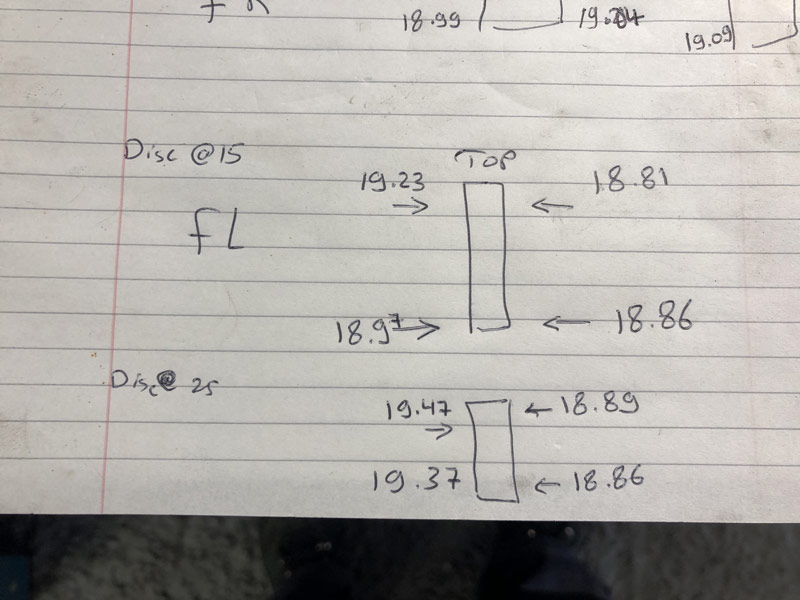
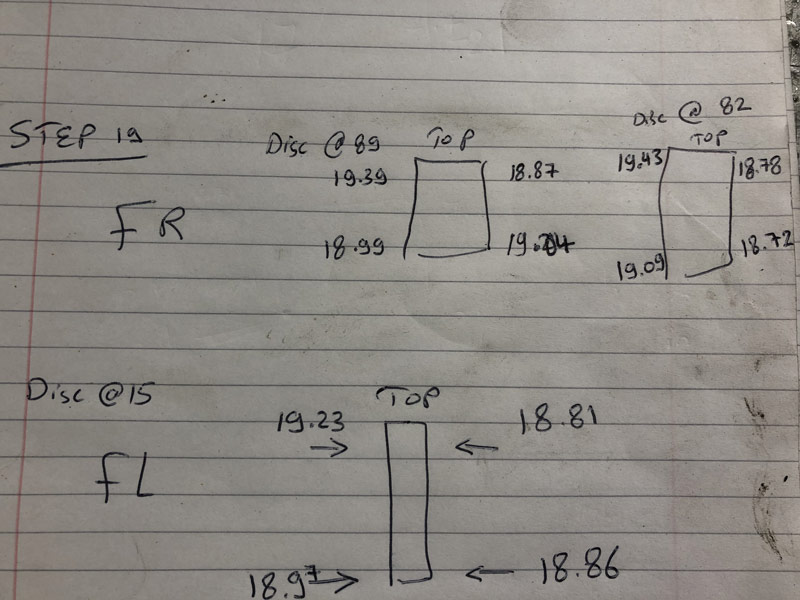
This confirmed the total variation of the complete braking assembly and provided the figures required to compare the installation with AP Racing’s specified tolerances.
Fault Identification
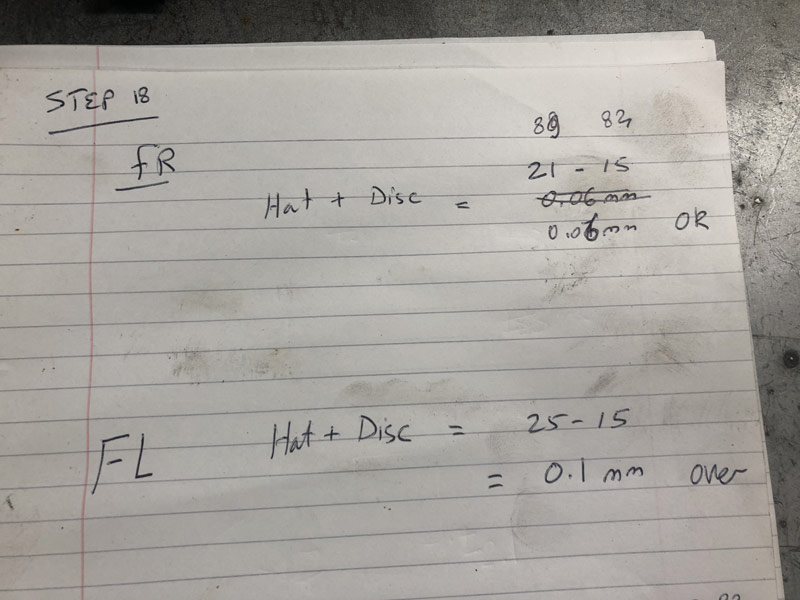
The readings showed that the left-hand assembly hat was slightly beyond the acceptable limit. The hat is the centre, hat-shaped portion of the brake assembly that mounts the brake disc to the wheel hub.
The variation was only approximately 0.1 mm outside tolerance. Although this sounds insignificant, at braking speeds and temperatures it was enough to cause the vibration experienced by the driver under heavy braking.
The staged measurements confirmed that the left-hand brake hat was responsible rather than the hub, brake pads or replacement disc.
Replacement Brake Hat
The findings were reported to AP Racing, together with the measurements taken during the investigation.
AP Racing supplied a replacement brake hat under warranty, and the defective component was removed and replaced.
The assembly could then be returned to its correct operating tolerance without replacing unrelated parts.
Why It Matters
This project demonstrates why accurate diagnosis is essential when resolving performance and motorsport braking problems.
The car was fitted with respected, high-quality components, and several parts had already been replaced. However, component quality alone cannot compensate for a dimensional variation within the assembled system.
A difference of just 0.1 mm was enough to cause noticeable vibration during heavy braking.
Without precise measurement, the owner could easily have continued replacing discs, pads or other components without eliminating the fault.
The diagnostic process allowed Kent Motorsport to:
- Test each part of the assembly individually.
- Identify the exact point at which excessive variation was introduced.
- Avoid unnecessary component replacement.
- Provide AP Racing with clear evidence of the fault.
- Restore the brake system to the required tolerance.
This type of problem solving is particularly important on track and competition vehicles, where braking performance, consistency and driver confidence are critical.
The Result
Following installation of the replacement brake hat, the BMW returned to the track for testing.
The owner reported that the braking vibration had completely disappeared and that the AP Racing system was performing beautifully.
The completed repair restored:
- Smooth braking under heavy load.
- Consistent brake performance.
- Driver confidence on track.
- Correct operation of the floating disc assembly.
- The full performance expected from the AP Racing brake system.
Most importantly, the problem was resolved through careful diagnosis and evidence-based measurement rather than repeated parts replacement.
Project Gallery
The project gallery includes:
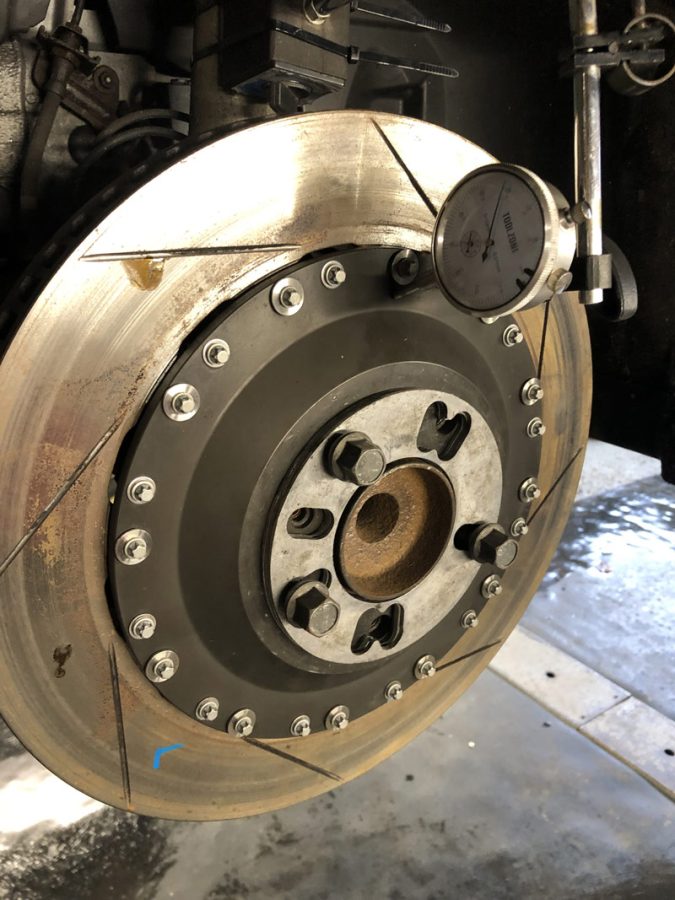
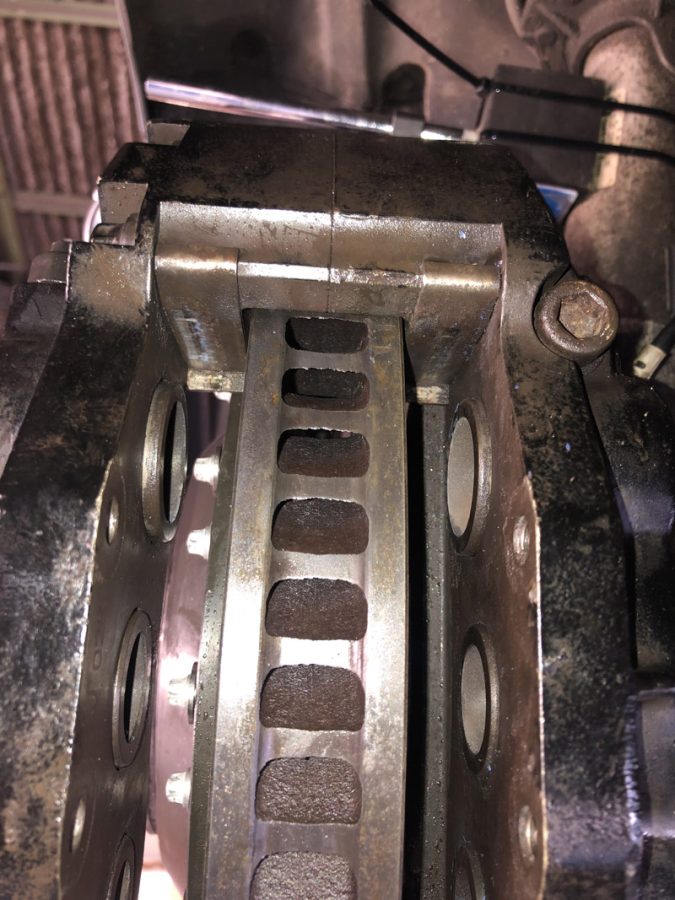
- The AP Racing brake installation.
- The floating disc and brake hat assemblies.
- The measurement equipment used during diagnosis.
- The handwritten readings recorded for each stage.
- Comparison of the left- and right-hand assemblies.
- Installation of the replacement brake hat.
The measurement notes are particularly valuable because they demonstrate the level of precision required to identify such a small but significant fault.
Related Services
Kent Motorsport provides diagnostic, preparation and repair services for performance, track and competition braking systems, including:
- Performance Brake Diagnosis
- Race and Track Brake Preparation
- Brake Disc and Pad Installation
- Floating Brake Disc Inspection
- Brake Runout Measurement
- High-Temperature Brake Fluid Replacement
- Brake System Upgrades
- Race Car Preparation
Whether a car is suffering from vibration, inconsistent braking, overheating or reduced driver confidence, Kent Motorsport takes a methodical approach to identifying the cause before recommending a solution.
Experiencing a braking problem that replacement parts have not solved? Contact Kent Motorsport for accurate diagnosis and a properly engineered repair.